

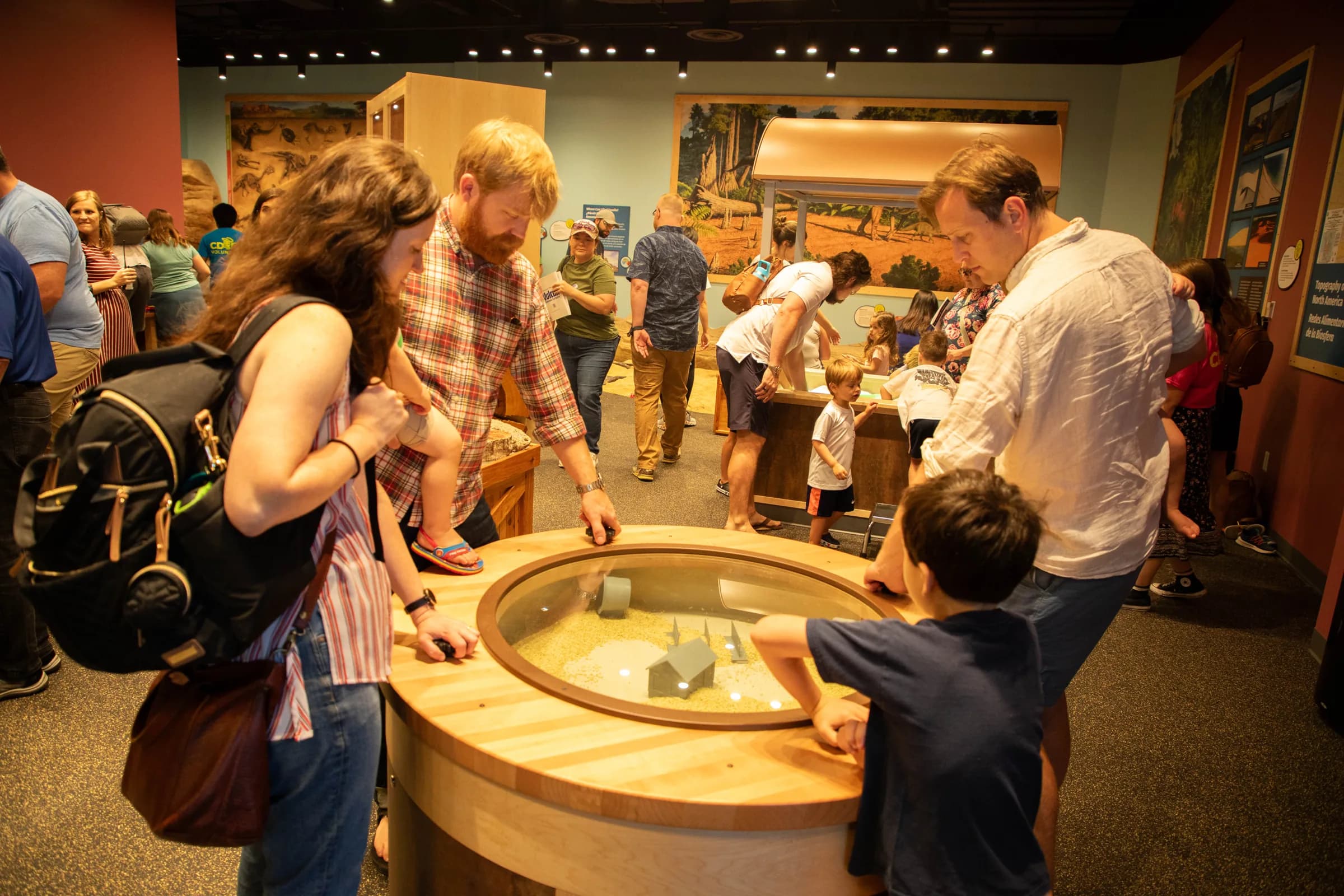
Students gather around a Museum educator at a table in UnEarthed.
Bring the class. Or we'll come to you.
Standards-aligned tours in the Museum and hands-on lessons in your classroom, from certified teachers on CDM's Outreach team.
Field trips.
Book at least three weeks ahead. Pay by check or card at check-in. Teachers, bus drivers, and required staff are free.
Discovery Tours
Explore our exhibits in this two-hour self-guided tour. Includes 1 teacher per classroom. 1 adult per student is permitted with paid general admission.
- Grades
- PreK – 5th (suitable for some middle schools)
- Length
- 2 hours
- Group
- 20 – 150 students
- Price
- $10 per student · $5 for Title I schools
STEM Tours
Experience our STEM-based exhibits, UnEarthed and STEM Zone, plus a 30-minute science demonstration in the Imaginatorium and a 35-minute lab experience, all connected to a chosen topic. Includes 1 teacher and 1 additional adult for the supervision of students per classroom (additional adult chaperones cannot be accommodated due to room capacities).
Choose a topic
Electrified (Grades 3–5)
Electricity is a powerful force that we use every day. Investigate static and current electricity, build and test circuits using conductors and insulators, and even explore electromagnetism!
Topics explored include: Static and Current Electricity, The Role of Conductors and Insulators in Open and Closed Circuits, Electromagnets
Sense-sational Science (Grades K–1)
When science seems like magic, curiosity leads to discovery! Students explore the science behind surprising phenomena and discover the concepts that make the seemingly impossible possible.
Topics explored include: The Five Senses, Scientific Thinking and Questioning, Effects of Heating and Cooling on Matter
Forces and Motion (Grades 3–5)
Forces are all around you, even the ones you can’t see! Experiment with gravity, shoot rockets, and race objects of differing masses to explore Newton’s Law of Motion and Gravity.
Topics explored include: Gravity, Newton’s Laws of Motion, Balanced and Unbalanced Forces
Simple Machines (Grades 3–5)
Simple Machines make work easier! Using a variety of simple machines, students will understand the relationships between forces, load, and work.
Topics explored include: Relationship between Force, Work, Load, Simple Machines (Levers, Inclined Planes, Screws, Wedges, Wheels and Axles/Pulleys), Identifying the Mechanical Advantages of Simple Machines
Making Waves (Grades 1–4)
Let’s make some waves! Explore the different types of waves by playing with sounds and lights, using radios, and vibrating water.
Topics explored include: Electromagnetic and Mechanical Waves, Components of Sound (Vibration, Medium, Receiver), Transparent, Translucent, Opaque, and Reflective Materials
States of Matter (Grades 2–5)
Matter makes up everything around us! Examine gases, solids, and liquids, investigate the factors that can change states of matter, and investigate mixtures.
Topics explored include: Atoms as the Building Blocks of Matter, States of Matter and their Properties, Effects of Heating and Cooling on Matter
- Grades
- K – 8th, by topic
- Length
- 2½ hours
- Group
- 25 – 100 students (divided into classes)
- Price
- $15 per student · $7.50 for Title I schools
Imagine! Tours
This arts-based tour exclusively for kindergarteners includes creating clay pots in the Art Studio, baking with dough in our teaching kitchen, and exploring local arts and cultural traditions in our ArtSpace exhibit. Includes 1 teacher and 1 additional adult for the supervision of students per classroom (additional adult chaperones cannot be accommodated due to room capacities).
- Grades
- Kindergarten only
- Length
- 2 hours
- Group
- 20 – 75 kindergarteners
- Price
- Free for Hamilton County Schools kindergarteners through funding provided by ArtsBuild’s Imagine! program · Outside Hamilton County Schools: $15 per student ($7.50 for Title I schools)
Reservations: ssw@cdmfun.org · (423) 648-6040
Outreach lessons in your classroom.
Our knowledgeable team of certified teachers deliver standards-aligned, hands-on learning experiences to your classroom, homeschool co-op, after-school program, troop, or club. Students rotate through stations that reinforce the topic concepts.
Request a lesson- Length
- 60 minutes
- Price
- $150 per lesson plus travel
- Class size
- Maximum number of students varies by grade level
- Book
- At least two weeks ahead. Availability is limited, and lessons fill quickly.
- Who it's for
- K–8 classrooms, homeschool co-ops, out-of-school-time providers, faith-based organizations, scouting troops, clubs, and enrichment or remediation programs.
Lesson library
2026–27 school yearOpen a grade band to read every lesson, then request the one you want on the booking form.
Early childhood
8 lessonsDevelopmentally appropriate learning experiences that engage three- and four-year-old children.
Lights in Our Sky · Lights and Shadows · Bugs! · Engineering Ramps and Pathways · Mixing a Rainbow · Orchestrating Sounds · Sensing the Five Senses · Wacky Weather
Lights in Our Sky
Develop your learner's curiosity about things in the sky. In this lesson, learners investigate the sun, moon, and stars and grow their understanding of the universe.
Lights and Shadows
Learners will explore the dynamics of light, engage in shadow play, experiment with shadow puppets, and trace shadows, leading to a stronger awareness of how light creates shadows.
Bugs!
Children will observe, graph, create, and imagine while they look closely at insects and arachnids and their life cycles during this lesson.
Engineering Ramps and Pathways
Children will become architects and engineers as they create pathways for objects to travel. Using the engineering design process, learners will test different materials and compare and contrast results.
Mixing a Rainbow
Mix, fizz, spin, splat! Learners will explore color theory in a variety of modalities and retell a familiar story about how primary colors make secondary and tertiary colors.
Orchestrating Sounds
Learners explore the different sections of the orchestra while investigating pitch, volume, and rhythm. They will experiment with the sounds everyday objects make and be encouraged to play real instruments.
Sensing the Five Senses
How do our senses help us relate and respond to the world around us? Learners expand their understanding of the five senses and their importance through immersive play.
Wacky Weather
Investigate weather and the seasons using storytelling props and scientific tools. Learners classify types of weather and experience a windy day with our portable wind tunnel!
K – 2
9 lessonsExcite and educate your students in grades K–2 with these hands-on instructional lessons.
Full of Energy · Good for You · Machines at Work · Magnetic Magic · Masks of the World · Rockin' with Rocks & Minerals · Visit the Vertebrates · Weather and the Water Cycle · World of Waves
Full of Energy
Explore different forms of energy (static, current, solar, kinetic, potential, sound, magnetic, and heat) and investigate their effects on objects by modeling energy transfer through circuits and experimenting with balanced and unbalanced forces.
Good for You
Learn about nutrition by eating a rainbow of fruits and vegetables, explore the effects of exercise on the body, and strengthen awareness of healthy hygiene practices.
Machines at Work
Evaluate the effects of push and pull on objects, investigate the six classes of simple machines, and apply them to real-world situations.
Magnetic Magic
Use appropriate tools to make observations, develop and refine design ideas, and explore cause-and-effect relationships through investigations with magnets.
Masks of the World
Recognize and apply symmetry and pattern, compare and recreate artistic characteristics from various cultures and time periods, and create a unique mask using diverse art elements and techniques.
Rockin' with Rocks & Minerals
Understand the processes that form rocks and minerals, differentiate between living and nonliving organisms, and test the physical attributes of rocks.
A limited number of lessons are available at no cost through a partnership with Vulcan Materials Company.
Visit the Vertebrates
Classify animals based on their characteristics and survival needs, observe hereditary traits shared between young and their parents, and explore how animals adapt to their habitats.
Weather and the Water Cycle
Explore the phases of the water cycle (evaporation, condensation, and precipitation), use meteorological tools to measure weather characteristics and patterns, and compare Earth's natural cycles such as erosion, weather events, and seasons.
World of Waves
Classify objects as transparent, translucent, opaque, or reflective; demonstrate cause and effect on various materials to observe resulting waves; and create and analyze wave patterns.
3 – 5
11 lessonsStudents in grades 3–5 will enjoy these standards-aligned, interactive lessons.
Electrifying Experiences · Energy Is Everywhere · Engineering · The Importance of Pollinators · It's a Plant's World · Magnetic Forces · Investigating Weather and Climate · All About Ecosystems · Simple Machines · Unearthed · What's Up with Matter
Electrifying Experiences
Explore both current and static electricity, create circuits to demonstrate energy transfer through current electricity, and investigate how energy transfer can be used to create an electromagnet.
Energy Is Everywhere
Recognize that energy is present in moving objects and understand the relationship between kinetic and potential energy; apply scientific principles to design, test, and refine a device that converts electrical energy to other forms using simple open or closed circuits; and acknowledge the sun as the ultimate source of energy on Earth.
Engineering
Design solutions to real-world problems considering specific criteria and constraints, explore how engineers improve technologies to enhance benefits, reduce risks, and meet societal needs, and evaluate experiments to determine if mixing substances causes changes in their properties.
The Importance of Pollinators
Analyze the internal and external structures of land animals and plants that support survival, growth, behavior, and reproduction; infer how adaptations help them thrive in land biomes; and use evidence to explain how variations among pollinators within the same species can enhance their survival and the survival of the plants they pollinate.
It's a Plant's World
Analyze and label the internal and external structures of plants to understand their functions, develop models of terrestrial and aquatic food chains to describe energy flow among producers, herbivores, carnivores, omnivores, and decomposers, and investigate the role of carbon in photosynthesis.
Magnetic Forces
Investigate the cause-and-effect relationships between magnets, solve problems using magnetic interactions, and explore how to create an electromagnet.
Investigating Weather and Climate
Explore and explain the water cycle on Earth, use tables, graphs, and tools to describe weather and climate, and investigate natural hazards and their effects on humans and the environment.
All About Ecosystems
Develop models of terrestrial and aquatic food chains to illustrate energy flow among producers, herbivores, carnivores, omnivores, and decomposers; explore adaptations that help animals survive in changing environments; and investigate an owl's diet by dissecting an owl pellet.
Simple Machines
Explore cause-and-effect relationships between energy, force, direction, and motion of materials; identify and demonstrate how the six different simple machines serve various purposes; and evaluate the effectiveness of multiple design solutions based on given criteria and constraints.
Unearthed
Use fossils to learn about the past, observe how mechanical weathering and transportation shape the landscape, and analyze data and maps to interpret landforms and Earth's layers.
A limited number of lessons are available at no cost through a partnership with Vulcan Materials Company.
What's Up with Matter
Describe the properties of solids, liquids, and gases, recognizing that matter is made of particles too small to see; compare physical and chemical changes by observing physical characteristics; and analyze data to demonstrate that matter is conserved even when it changes form or appears to vanish.
6 – 8
10 lessonsExperiments and activities designed to inspire students in grades 6–8.
Atoms All Around · Bio-Basics: A Cell-abration! · All About Ecosystems · Energy Transformations · Forces of Physics · The Mystery of Electromagnets · Sustainable Solutions · Systems on Earth · Totally Tectonic · What Does It Take for Life?
Atoms All Around
Develop and use models to illustrate atomic structure, including subatomic particles with their positions and charges; classify materials as pure substances or compounds based on their composition; and create compounds while exploring their atomic makeup.
Bio-Basics: A Cell-abration!
Develop and construct models to identify and explain the structure and function of major cell organelles, model passive transport and how cells maintain homeostasis, and understand the process of mitosis that creates identical daughter cells.
All About Ecosystems
Explore how changes in biodiversity affect ecosystem stability and natural resources, evaluate the impact of biotic and abiotic factors on biomes, and analyze fossil data to uncover patterns about past life.
Energy Transformations
Analyze and compare the properties and sources of kinetic, elastic potential, gravitational potential, chemical, and thermal energy; conduct investigations to demonstrate how heat transfers through radiation, conduction, and convection; and design experiments to explore the relationship between magnetism and electricity in generators and motors.
Forces of Physics
Investigate the relationship between force, mass, and motion; demonstrate how balanced and unbalanced forces affect objects considering gravity, inertia, and friction; and analyze and explore Newton's laws.
The Mystery of Electromagnets
Design and conduct investigations to explore the relationship between magnetism and electricity in electromagnets, provide evidence that force fields exist between objects without direct contact, and demonstrate the Earth's magnetic field.
Sustainable Solutions
Plan and conduct an investigation comparing ethanol production by yeast with different feedstocks, measure and observe chemical changes during fermentation, and construct and revise explanations based on evidence for matter cycling and energy flow in anaerobic conditions.
Systems on Earth
Investigate convection patterns caused by uneven heating of the Earth; explain how atmospheric flow, geographic features, and ocean currents influence regional climates through heat transfer; and evaluate how interactions among air masses, pressure systems, and frontal boundaries lead to weather conditions and severe storms.
Totally Tectonic
Explain the processes and forces that form igneous, sedimentary, and metamorphic rocks; demonstrate changes in the lithosphere such as plate movements, boundaries, and sea-floor spreading; and evaluate how minerals affect crystalline structures and rock formation.
This outreach lesson is sponsored by Vulcan Materials Company.
What Does It Take for Life?
Evaluate and predict dominant and recessive alleles from parents to offspring; demonstrate and explain photosynthesis, cellular respiration, and anaerobic respiration in the cycling of matter and energy flow; and develop an argument explaining how behavioral and structural adaptations influence survival and reproductive success in animals and plants.
Questions? Reservations: ssw@cdmfun.org · (423) 648-6040
Also on the road.
Family Nights
Nine hands-on activities for up to 300 participants, ages 4 and up. We bring the materials, train your presenters, and stay on site.
Choose a topic
Full Steam Ahead
Design and construct a variety of prototypes and test models. Families will hone their science, technology, engineering, art, and math skills.
Health Night
Jump into healthy habits! Families concoct a healthy recipe, are “grossed out” by their bodily functions, and evaluate their well-being.
Multicultural Math
Families “travel” to eight different countries and engage in activities specific to the culture of the country while measuring, graphing, using fractions, and engaging with mathematical operations.
STEM Night (Middle School)
Study aerodynamics, experiment with alternative fuel sources, and investigate old and new technology while you use science, technology, engineering, and math to solve these real-world puzzles. For middle school.
The Science of Art
Families will explore the art of artists and the science of scientists while they work together on nine fun, engaging, and creative projects that demonstrate science concepts.
Young Author’s Literacy Night
These activities allow families to focus on reading, writing, and other language skills through fun discussions, storytelling, and even making a stop motion film.
Sustainable Solutions (Middle School)
Investigate the possibilities of the future by exploring new technologies that encompass engineering, biology, genetics, botany, agriculture, chemistry, ecology, and environmental science! For middle school.
$550 plus travel
Request a Family NightSTARLAB
A mobile digital planetarium that comes to your school. Two lesson options, by age: Primary: Explore the wonders of space as students investigate natural cycles like day and night, moon phases, and seasons. They’ll compare planets based on their unique features and discover constellations while exploring their locations and historical significance. Elementary: Discover our place in the universe as students explore the Sun’s role in the solar system, examine space objects like asteroids, meteoroids, and comets, and investigate how constellations have helped people navigate the night sky and understand Earth’s movement.
Ask about datesCDM loves teachers!
Free admission with your school ID
Teachers get in free. Show your school ID at Guest Relations.
EdDiscovery membership
A discounted membership for educators: one teacher and one named adult in the same household and up to four children.
About EdDiscoveryHomeschool families
Homeschool families qualify for the same discounts, including EdDiscovery, with documentation. See our Homeschool program for classes just for you.
Homeschool program